Welcome to my first book review! If you’d like to learn more about why I’m writing a few book reviews and what my hopes are for the reviews, check out my explanation!
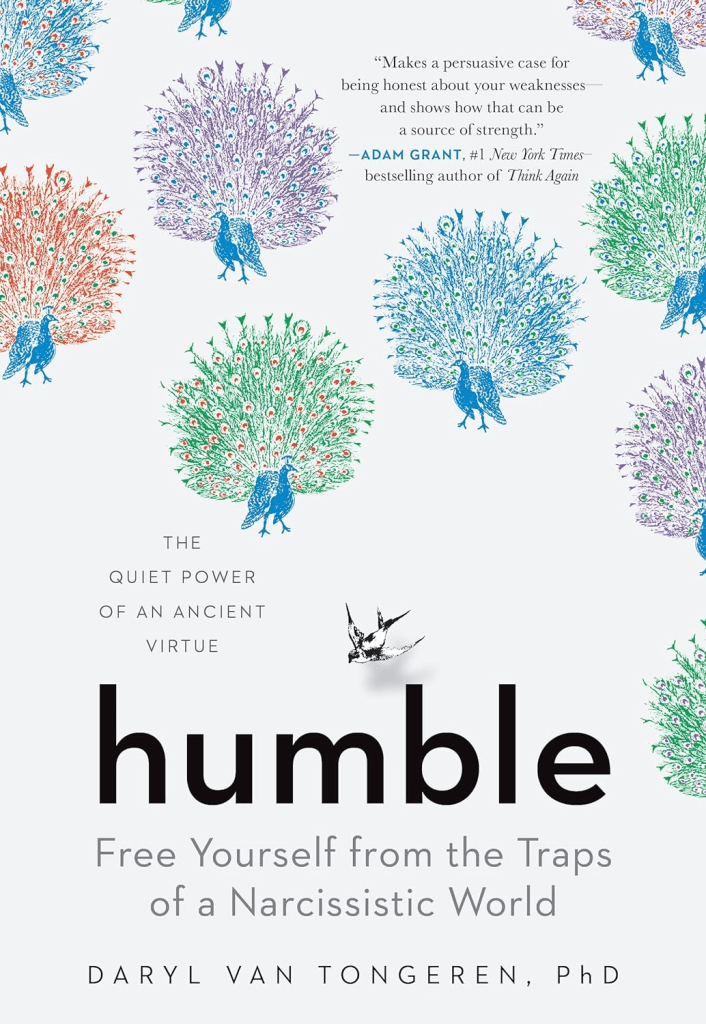
Book: Humble: Free Yourself from the Traps of a Narcissistic World
Author: Daryl van Tongeren
Publisher: The Experiment
Publishing Year: 2022
Summary:
Daryl van Tongeren defines humility as having “a sense of enoughness—an unconditional worth and value.” Throughout the rest of the book, he fleshes out what that definition means, how we can cultivate humility in our own lives, and the effect that humility can have on our lives and in the world. Using the three-part explanation of humility as “knowing yourself, checking yourself, and going beyond yourself,” van Tongeren shares four practical categories of ways to become more humble, each with a chapter devoted to exploring such a concept: seeking feedback, reducing defensiveness, building empathy, and self-regulation. Finally, he shares how humility can improve our lives and the world through bridging divides, making progress, and creating and maintaining a flourishing community (each with a devoted chapter of exploration). In a field of study with shockingly little literature, van Tongeren seems to support every claim about humility and its impact with a research study and digestible interpretation, interspersing personal anecdotes throughout.
Three main takeaways:
- Humility is, to use van Tongeren’s word, “enoughness,” (pages 2 and 13) knowing that regardless of what you do, you have unconditional worth and value. Though not a Christian book, this concept connects beautifully to the idea of the Imago Dei, the image of God. Because we believe that each person is created in the image of God, then we believe that each person has immeasurable worth. By living out of that worth, rather than trying to earn worth from others, we are able to live as humble people. As van Tongeren says, “Our value in this world extends far beyond what we create. Humility grants us the security to know that we have inherent worth and dignity apart from our success or achievements” (page 79).
- Van Tongeren identifies three features of humility: “an accurate self-assessment, the ability to regulate one’s ego, and an orientation toward other people,” or, put more simply, “knowing yourself, checking yourself, and going beyond yourself” (page 11). This highlights to me the importance of surrounding yourself with other people who are able to speak into your life with truth and grace and help you begin to overcome blind spots.
- Van Tongeren shares multiple chapters’ worth of material regarding how to cultivate humility in your life. As a pastor, I found his suggestions for enhancing humility as a religious leader to be enlightening: “strengthening relationships with others (being vulnerable, seeking feedback, asking for accountability), private worship practices (prayer, meditation, reading scripture), self-reflection (introspection, time in nature), self-care (rest, exercise), or service (helping others at home or at church)” (pages 236-237). It’s of little surprise that religious leaders need more humility, for as van Tongeren points out, “there is a notable degree of narcissism among many church leaders” (page 236). These are helpful practices for “checking myself” as I seek to be a humble leader, as Jesus is.
Three quotes:
- “Humility is a way of approaching ourselves, other people, and the world around us with a sense of enoughness—an unconditional worth and value—that opens us to the world as it is.” (Page 2)
- “When you’re looking for every opportunity to stroke your own ego, you will lose most of your relationships along the way.” (Page 144)
- “Crafting ideological echo chambers is an act of arrogance. It signals that we’re so convinced we’re right, we only need other people around who will affirm the superiority of our beliefs.” (218)
What “hole” the book fills on the shelf of literature:
Humility seems to be a widely under-researched and under-discussed topic, especially given its importance to our world. This book begins to fill a vast gap in literature by being an introductory work of an important topic.
Review:
Humility is one of those concepts that—particularly in Christian circles—we talk a lot about, but until you actually have to define it, may not fully understand. As a first book of its kind in exploring humility, this is both a practical and a theoretical book, with both personal stories and practical tips, as well as dozens of research studies cited and discussed. I’ve always been captivated by C.S. Lewis’ quote: “Humility is not thinking less of yourself, it’s thinking of yourself less.” This book helps me to better understand the meaning of that and how to cultivate deeper humility, a particularly important skill in the pastoral field in which narcissism frequently rears its ugly and damaging head. I’m glad this book exists and I’m glad I read it.
Three types of people that might enjoy the book:
- Ministry leaders
- Those who believe that are too self-focused
- Readers of psychology literature
Interested in reading Humble by Daryl van Tongeren? You can buy it on Amazon here.
Interested in getting email updates each time I write a new blog post? Subscribe here:


 Hunter Bethea
Leave a comment