I don’t know about you, but I tend to be the kind of person that thinks in terms of two categories: good or bad. If something happens to me, I subconsciously ask myself, “Is this good or bad?” and then respond accordingly. Can you relate?
On my recent trip to Turkey and Greece, though, I began realizing that some things aren’t good or bad; they just are. What makes them “good” or “bad” (if we even want to continue using those categories) is how we respond to them.
As I followed in the footsteps of Paul, there were some sites that (in my faulty good/bad categorization), were “good.” Take, for example, the river where Lydia was baptized. With Lydia being the first known European convert to Christianity and proof for millennia that Christianity is open to all people, regardless of gender, race, nationality, etc., that spot was categorized in my brain as “good.”

But there were some sites that I categorized as “bad.” Just a few hundred yards away from that river was a prison where it was suspected that Paul and Silas were held. Because of what that prison represented—the persecution of Paul—that prison was categorized in my brain as “bad.”
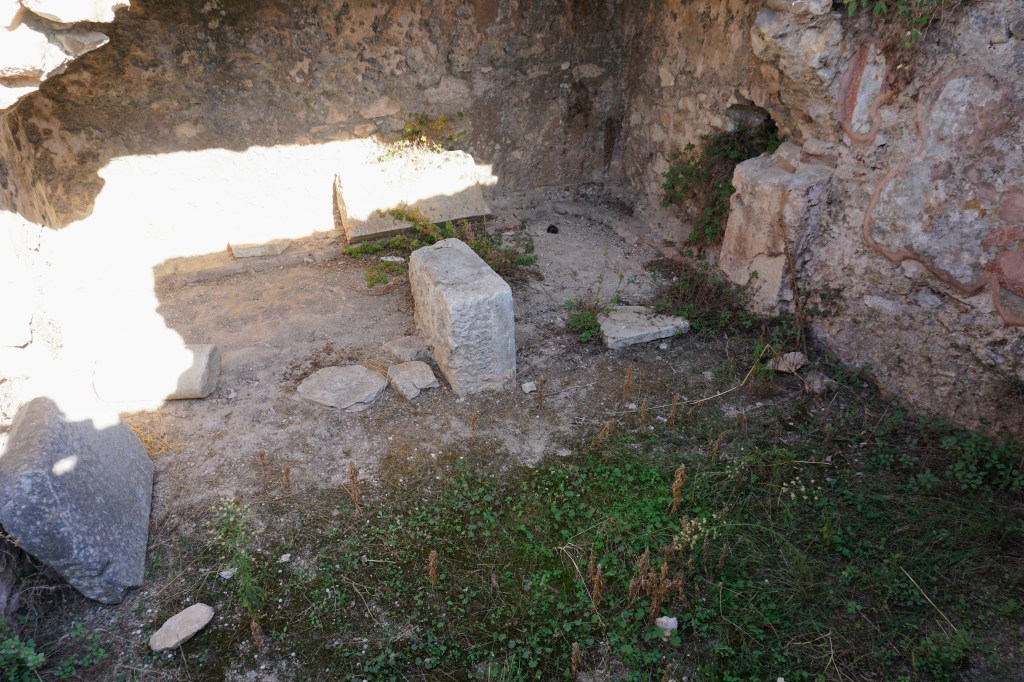
But then I got to a place that didn’t fit my categorization of “good” or “bad.” Towards the end of our tour, we got to Ephesus, Turkey, a city that has been under excavation since the American Civil War (aka, an exceptionally long time, especially for an archaeological site). Ephesus is stunning, a playground of Roman and Greek architecture. Even after seeing nearly a dozen impressive sites, Ephesus was jaw-dropping.
At the end of the Ephesian tour was the theater, one of the two most impressive ancient theaters I saw in Greece and Turkey (the other being in Laodicea). The signage at the theater said that Paul had preached in the theater, though there’s no historical evidence of that. (It was common for these historical sites to take legends and historical possibilities and state them as historical facts.)
I asked a friend to take my picture (one of my favorite pictures of the trip, in large thanks to the photo editing of one of my traveling companions, Brooke) and headed on to the archaeological museum on site.
As I walked away, I subconsciously thought, “That’s a good site.”
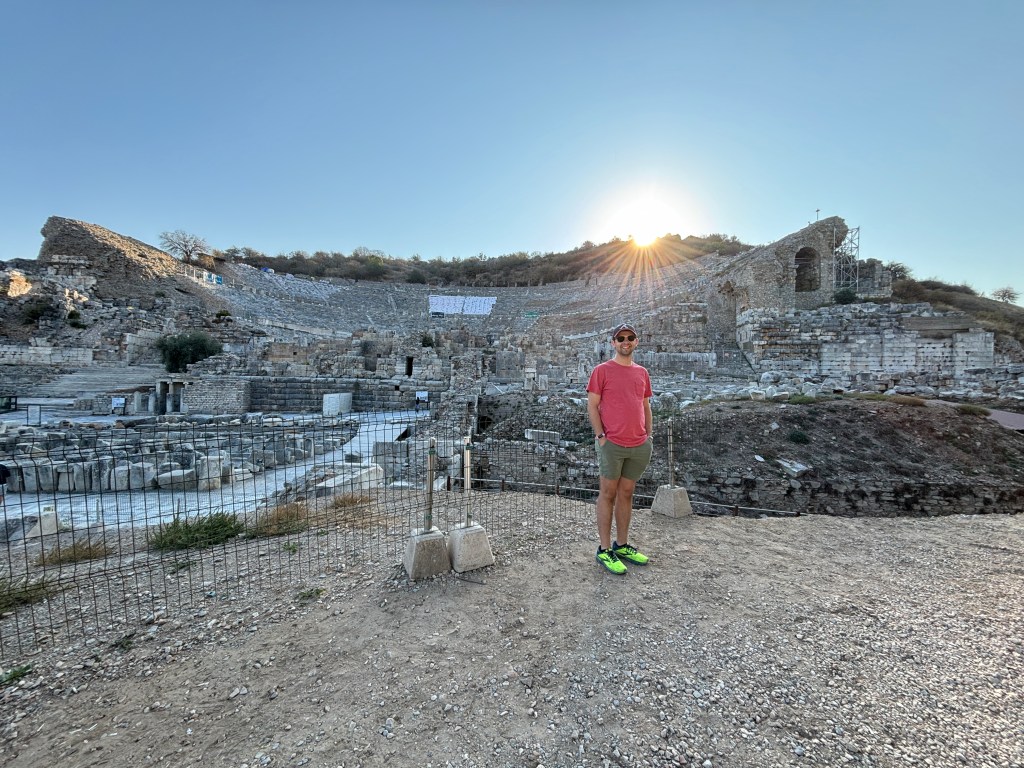
Later, though, as I was reading about the Great Theater of Ephesus, I learned something else about this historical site: this was one of the places where Christians were fed to lions as a horrific form of persecution.
I thought to myself, Hm. So is this a good site or a bad site?
And that’s when it finally clicked for me: while there are things that are unequivocally good and unequivocally bad in this world, many things are neither good nor bad. They just are. And often, they bring about things that are both good and bad.
As I was pondering this new-found realization, I thought about the very road I was walking on: the Roman road.

In my world history classes in school growing up (see, teachers, I was paying attention!), I learned that because of the pax Romana—the Roman peace—the Romans built roads throughout their empire (hence the phrase, “all roads lead to Rome.”) Because of the peace that Rome ensured throughout their empire, the roads were the safest in history, increasing trade, transportation, and the spread of culture.
Because of the pax Romana, the Gospel spread unimaginably quickly in the 1st century. This wouldn’t have been possible without the pax Romana and its Roman roads. (It was as if God knew just the right time to send His Son to be with us.)
Because of the pax Romana, the Gospel spread quickly.
But it’s also because of the pax Romana that Jesus was killed.
You see, the pax Romana wasn’t a true peace. It was a costly peace. Anything that threatened the Roman empire had to be shut down… and shut down firmly.
So when an insurrection began to happen among the Jews in Jerusalem, far away from the Empire’s center in Rome, a certain man named Pontius Pilate knew that his superiors wouldn’t be happy if he let it slide. So, even though he saw nothing wrong with a man named Jesus from Nazareth, he gave permission for the Roman soldiers to crucify Jesus.
All in the name of the pax Romana.
But why does it matter whether we see things in the categorization of good and bad?
In my own experience, when I categorize something as good, I’m less willing to see anything wrong with it. For example, if I see a political policy and think, This is good, I may be unwilling to see the harm that specific policy causes people that aren’t like me.
When I categorize something as bad, I’m less willing to respond well to it. If something happens to me to which I say, This is bad, then I allow myself to respond poorly to it, rather than say, Okay, this just is. Let me respond to it the best I know how.
Let me give a recent example.
Throughout the late summer and early fall, I began running again. For a bit of context, I used to never consider myself a runner. I’d occasionally try to start running, but I would always set unsustainable goals and quickly burn myself out.
But in seminary, thanks to my seminary’s annual 5K/10K, I became a runner. Given my competitive nature, I wasn’t simply going to settle for a 5K, either. I trained for the 10K and, even though I didn’t enjoy most of the training, I finally found myself actually enjoying running.
There was one problem though. Each time I really got into running, I developed a pronated shin splint, often sidelining me for months at a time.
Towards the end of this past fall, I pushed myself a little bit too hard with some running shoes that were probably a little too worn and, alas, a shin splint developed. I immediately thought, This is bad.
After all, I’ve known running to not only be good for my physical health, but for my mental and spiritual health as well (which makes sense, given that all three are intertwined). History shows that when I get a shin splint, I tend to spiral mentally and spiritually.
But then I asked myself, Does this have to be bad? Or can I respond to it in a good way?
Sure, there was nothing inherently “good” about my shin splint. It hurt like heck and took away one of the best mental health practices I have. But I decided to try to respond to it in a good way. I began asking myself: how might God be inviting me to respond well in this situation?
Admittedly, I didn’t respond to the situation perfectly. I had some bad days where my mental, spiritual, and physical health were all less than ideal. But I also learned a lot. I was reminded that God has created limits in our world and that it is good to live within those limits. I began practicing other spiritual disciplines I had neglected for too long, practices like fasting and solitude. I even took my physical health seriously and went to see my primary care physician to help rule out a fracture and to learn how to take better care of my shins.
Over the last few months, as I’ve been contemplating this realization—that most things are neither good nor bad—I just couldn’t help but realize just how much emotional energy I’ve spent trying to categorize things as “good” or “bad.” Some things just are. What matters is how we respond to them.
Interested in getting my blog posts sent directly to your email? Put your email in the box below and click “Subscribe.”
Interested in reading some of my recent posts? Check them out below:


 Hunter Bethea
Leave a comment