If you’ve been on the Internet recently, you’ve probably seen the moment gone viral of Astronomer’s CEO Andy Byron and Astronomer’s head of HR, Kristin Cabot, being caught in an alleged affair. (And if you haven’t seen it, you now understand how vastly different each person’s Internet experience is due to social media algorithms, leading us to live in our own echo chambers, furthering our own biases and preferences, making us less able to empathize with others who think differently than us… but I digress.)
It’s a moment of embarrassment that the Internet has feasted on, leading to memes and even ads which poke fun at the situation and the two individuals involved. In other words, the Internet has responded by being the Internet.
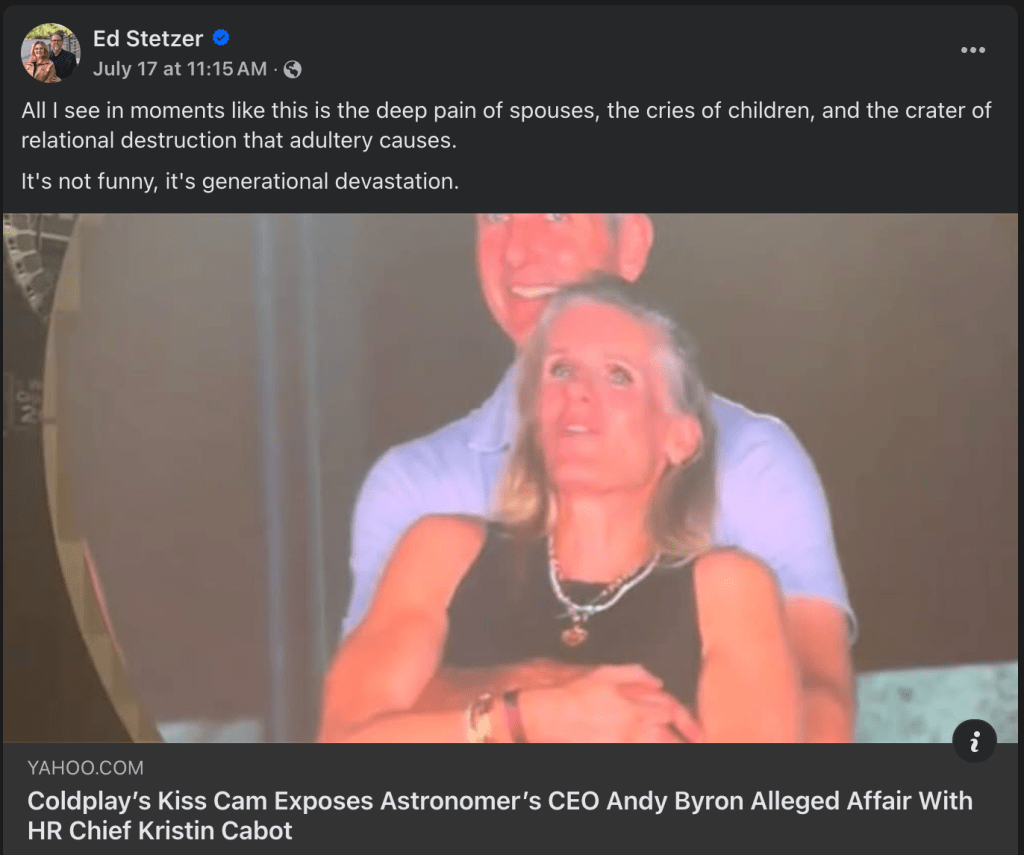
It’s also a deeply heartbreaking situation, as Christian pastor/scholar/theologian Ed Stetzer points out:
Amidst the jokes, memes, ads, and laments, I saw what was a supposed statement from CEO Andy Byron. (After more than 24 hours of thinking this was a real statement, I later learned that this was originally posted by a satirical X account, and not Byron himself, yet another reminder that you can’t believe everything on the Internet.)
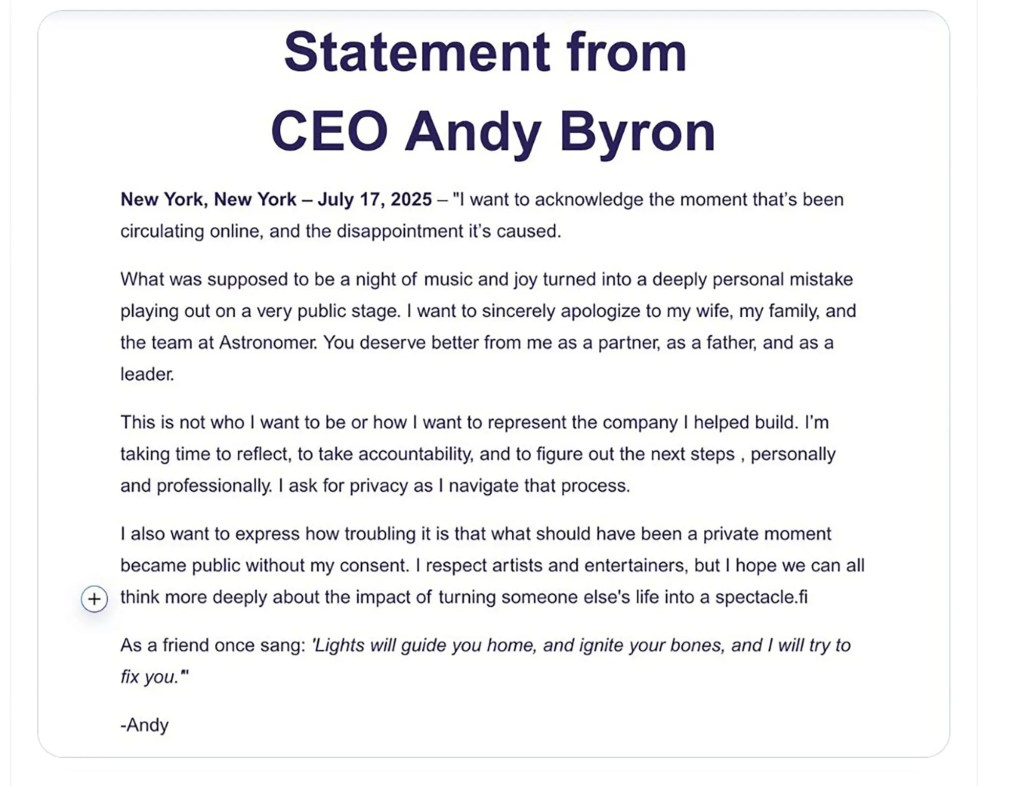
While I was still thinking this was Byron’s actual statement (for the record, he hasn’t put out any official statements at the time of writing), one line stood out to me: “I also want to express how troubling it is that what should have been a private moment became public without my consent.”
According to the ever-reliable (satire) Wikipedia, “Satire is a genre…, usually in the form of fiction…, in which vices, follies, abuses, and shortcomings are held up to ridicule.”
Regardless of the ethics of posting such satire, I think this “statement” points out what many of us believe in the Western world: What is done in private doesn’t affect others.
I’m here to tell you that’s wrong.
Many would agree with me, quipping, “What’s done in the darkness always comes to light.” But that’s not always true; at least not on this side of heaven.
But what is true is another quip, one that I find particularly helpful: “The things we do do something to us.”
Those things that we do—whether in private or public, alone or with others—change a who we are, even if only a little bit.
Any action—good, bad, or otherwise—has an effect on who we are and what we do in the future. That’s why I don’t believe it when people act as if what they do in the safety of their home or beyond closed doors doesn’t affect others. Because when you walk out of your home or you open that door, the person walking out is slightly different than the one that walked in.
In our individualistic culture, we think of the things we do as only affecting those involved. But this isn’t true. Instead, it affects anyone who relates to those involved.
This is obvious with an affair. Affairs don’t just affect the two people in the affair; they affect spouses and kids and coworkers and friends.
But it’s also true with the choices we make that aren’t plastered on every corner of the Internet.
When we choose to think judgmentally about someone, it changes us to become a person who is more judgmental of others. The next time we judge someone, we’re more comfortable with that judgment and may even rationalize why that judgment is right. This starts to infect our mind and we can begin seeping that infection into others around us too.
I think this is one of the reasons why sins—even seemingly private sins—were addressed as a community in the Old Testament. Most of the punishment and judgment of wrongdoing in Ancient Israel was done by and in the community.
Why? Because sin—even the most private of sin—affects the whole community.
But the same can be true of the good things we do in life, including the most personal and private of good things.
I’ve noticed that when someone comes to my mind and I stop to pray for them, the next time that happens, I’m more likely to pray for them. I’m also more likely to check in on them, to empathize with them, to see them in the way I think God sees them.
The smallest, most private acts we do, whether good or bad, affect everyone around us.
That’s why choices—good and bad—matter.
Want more reflections like this? Subscribe to my blog below and follow me on Facebook.
Want to read some of my recent blog posts? Check them out below!
- Why Do We Celebrate Lent?
- What We Lose When We Forget the Image of God
- Fasting and Abstinence: A Path to Dependence on God (the 19)
- The Five Best Books I Read in 2025
- Why Does Good Theology Matter?
This blog is a hobby for me, but it does cost some money to maintain. If you’d like to support this blog you can “buy me a coffee.” Thanks!

 Hunter Bethea
Leave a comment