In May, I was ordained an elder in the Global Methodist Church. Each clergyperson ordained in a Methodist denomination has to answer 19 historical questions asked by bishops going back to John Wesley’s (the founder of the Methodist movement) time. I thought I might share my responses to these questions in hopes of sharing a bit more about myself and about Methodism. This is the tenth and eleventh of the 19 questions. I hope it blesses you!
To read my other responses to the questions, check them out here:
- Have you faith in Christ?
- Are you going on to perfection?
- Do you expect to be made perfect in love in this life?
- Are you earnestly striving after perfection in love?
- Are you resolved to devote yourself wholly to God and to God’s work?
- Do you know the General Rules of our Church?
- Will you keep the General Rules of our Church?
- Have you studied the doctrines of the Global Methodist Church?
- After full consideration do you believe that our doctrines are in harmony with the Holy Scriptures?
- Have you studied our form of church discipline and polity?
- Do you approve our church government and polity?
- Will you support and maintain them?
- Will you exercise the ministry of compassion?
- Will you diligently instruct the children in every place?
- Will you visit from house to house?
- Will you recommend fasting or abstinence, both by precept and example? (Coming soon)
- Are you determined to employ all your time in the work of God? (Coming soon)
- Are you in debt so as to embarrass you in your work? (Coming soon)
- Will you observe the following directions?
(a) Be diligent. Never be unemployed. Never be triflingly employed. Never trifle away time; neither spend any more time at any one place than is strictly necessary.
(b) Be punctual. Do everything exactly at the time. And do not mend our rules, but keep them; not for wrath, but for conscience’ sake. (Coming soon)
10. Have you studied our form of church discipline and polity?
I believe that our discipline and our polity as Methodists is one of the foundations of what has made this movement continue to work for approximately 250 years. From the very beginning of Methodism, the structure and organization of the movement has sought to serve God and the movement of the people called Methodists, rather than serve the system itself or any individual or groups within the system. When we lose that, we lose what makes us good Methodists. John Wesley famously said, “I am not afraid that the people called Methodists should ever cease to exist either in Europe or America. But I am afraid, lest they should only exist as a dead sect, having the form of religion without the power. And this undoubtedly will be the case, unless they hold fast both the doctrine, spirit, and discipline with which they first set out.”[1] Through both classes in seminary and personal study (particularly of the Global Methodist Book of Doctrines and Discipline), I have studied our form of church discipline and polity and, as I’ll mention in following responses, I approve them and will support and maintain them.
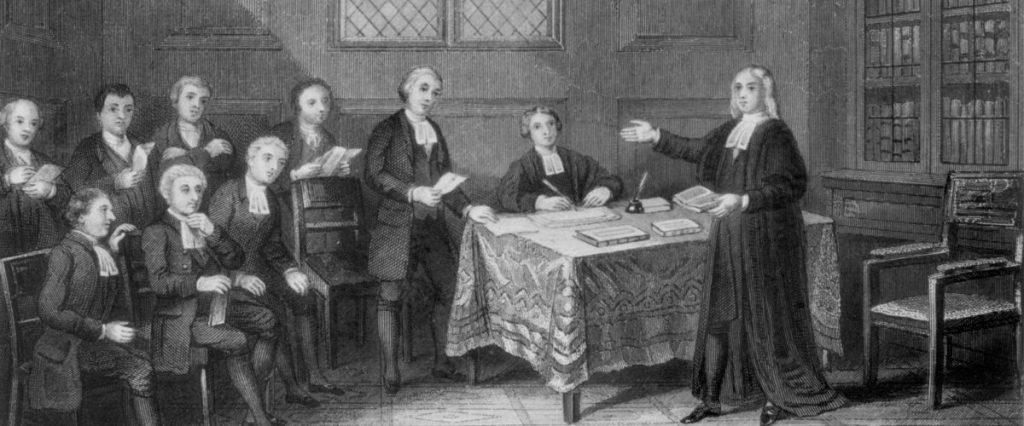
(Photo Credit: General Commission on Archives History)
11. Do you approve our church government and polity?
John Wesley once wrote, “What is the aim of any ecclesiastical order? Is it not to snatch souls from the power of Satan for God and to edify them in the love and fear of God? Order, then has value only if it responds to these aims; and if not, it is worthless.”[2] I believe that the church government and polity of the Global Methodist Church enables churches and pastors to “snatch and edify” the people of our communities around the world. We as clergy are not called to serve our church government and polity, but rather, to serve God. Our church government and polity are designed to help us serve God in our local contexts. Because I approve of the Global Methodist Church’s government and polity, I willfully submit myself to it as I serve God.
One of the challenges faced by the Global Methodist Church, which is itself truly global, is creating enough structure to enable churches of all sizes and in all places to minister well, without being burdened by undue strain and regulation. We must balance cohesion across the denomination and contextualization within our own communities. Despite this being a challenge, I believe our church government and polity strikes this balance well. One of the strengths I see in Methodism and the Global Methodist Church is the way in which our polity is more fluid than our doctrine. Many of our doctrines are constitutionalized—making them much more difficult to amend—whereas much of our polity is not. I think this is a healthy balance. In good conscience, I can approve our church government and polity, including the polity that a General Conference will meet regularly to continue to affirm and adapt to what God is doing in the people called Global Methodists.
1. John Wesley, “Thoughts Upon Methodism (1786)” in The Bicentennial Edition of the Works of John Wesley, ed. Richard P. Heitzenrater, vol. 9, The Methodist Societies: History, Nature, and Design, ed. Rupert E. Davies (Nashville: Abingdon Press, 1989), 527.
2. John Wesley, “Letter to John Smith, June 25, 1746,” quoted in Scott Kisker and Kevin Watson, The Band Meeting: Rediscovering Relational Discipleship in Transformational Community (Franklin, TN: Seedbed, 2017), 68.
Thanks for reading! As I continue this series, if you’d like to get my newest blogs sent to your email, subscribe below!
To learn more about me, click here. Or, to get in touch, click here.
Also, to read my book review of GMC Bishop Carolyn Moore’s book The 19: Questions to Kindle a Wesleyan Spirit, check it out here.
And finally, this blog is a hobby for me, but it does cost some money to maintain. If you’d like to support this blog, you can purchase any of the books I’ve mentioned in this post using the links on this blog, or you can “buy me a coffee.” Thanks!

 Hunter Bethea
Leave a comment