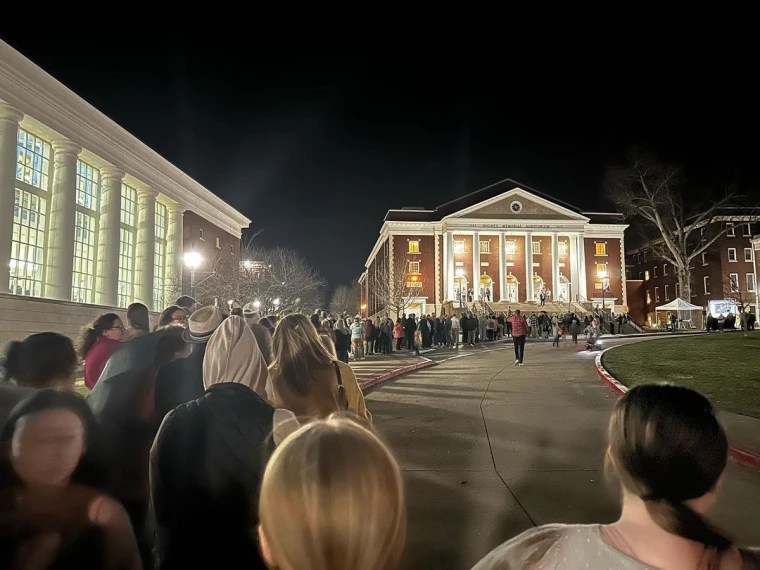
As I mentioned in my introductory post to this series, one of the many things that intrigued me about the Asbury University outpouring was the way that God made it both deeply personal and deeply communal. One way this played out was that, despite hearing many unique stories and testimonies, commonalities emerged. Sometimes these commonalities were words that I heard people using over and over to describe what God was doing.
One word in particular stood out to me:
“Steward”
Depending on your denomination, you may think of “stewardship” as only one thing: giving money (often accompanied by a month-long sermon series).
But in this context, several different people used the word to describe how Asbury University’s leadership handled the outpouring. They stewarded what God had given them well.
What do I mean by that?
For some reason that only God knows, God chose a small Christian college surrounded by horse farms to be a place where He poured out His Spirit. In doing so, God gave AU’s leadership the responsibility of administering, ordering, and leading what He was doing. In other words, God called AU’s leadership to steward what He was doing.
The University’s leadership had an insurmountable task in front of them, one that surely would have been impossible without God.
On one hand, after the Chapel service continued for several hours, they realized the need for organization, structure, and even some control, lest someone with malicious intent try to take control of the movement of God (an unfortunate, but very real, actuality).
On the other hand, if the University took too much control of it, they could have created a barrier between what God wanted to do and what those in Hughes Auditorium (and, eventually, other spaces) needed to receive from God.
Before we talk about what the University did and how they modeled healthy leadership, let’s play both of these scenarios out.
Poor Stewardship: Undercontrolling
What would have happened if the leaders at Asbury University didn’t step in and begin adding organization to what God was doing? Honestly, the scenarios are endless.
When a guitar player’s fingers were starting to hurt, there would have been no one to pick up an instrument and relieve them. When hundreds of people used a single bathroom in an hour, there would have been no one there to clean it. When a microphone was available, people with malicious intent would grab it and begin teaching what’s contrary to God’s heart. When people were wanting someone to pray for them, there would have been no one around to pray. When a student shared a vulnerable testimony, their story would have been blasted across Facebook Live without their permission for the world to see. When thousands of strangers descended into our town, there wouldn’t have been security personnel to ensure the physical safety of those just wanting to meet with God.
In one word: Chaos.
Our God is not a God of chaos. When He looked at a world gripped by chaos, He brought order.
“Well,” some might say, “why not just led the Spirit lead?” I get the sentiment. I really do. There are times when it would be nice to have the Spirit do everything and us just sit back and receive His blessings.
In fact, I’m sure dozens of leaders at Asbury University (and those they leaned on for help… more on that later) would have loved for the Spirit to be the one cleaning the toilet, buying tissues, answering the phones, and scheduling the musicians. But the Spirit wasn’t doing that.
Why? Because the Spirit invites us to be stewards. To partner alongside Him as He does His work. And because there can be joy in partnering with Him.
Even if that partnership involves cleaning toilets.
Poor Stewardship: Overcontrolling
It’s no surprise that Gen Z (the generation nearly all Asbury University students are in) dislikes institutions. And honestly, for many valid reasons. Institutions have too often taken their power and used it for harm, or greed, or self-aggrandizement.
Asbury University could have done the same during the outpouring.
If the leaders of Asbury University had taken too much control of the outpouring—used their power in a way contrary to God’s heart—they would have created a barrier between God and those God wanted to minister to.
How could they have done so? Again, endless possibilities.
When students got to class and asked their professor if they could go back to Chapel, the professor would have said, “It’ll hurt your grade.” When staff clocked out, they would have turned off the lights in Hughes Auditorium and told students to “Go home.” When the eyes of the world turned to a small Christian college, the registrar would get up and tell everyone that “You too could experience this if you enrolled in such a prestigious university.” When professional worship leaders arrived, organizers could have handed them the microphone because “We want this to sound good.” When Fox News asked for an interview, the president could have said, “I’ll gladly tell you all about how I made this happen.”
In one word: Self-righteousness.
Overcontrolling something like this tells God that we need Him to play by our rules. That there are some things more important than what He is doing. That our fears will be realized if He doesn’t stop His funny business. That we can get what we deserve by riding the wave of this movement.
Doing so would have created a barrier between God and those God wanted to reach. Not an insurmountable barrier, mind you. The irony of overcontrolling something God is doing is that it’s merely a facade. We’re not actually in control. If God wants to smash through our barriers, He will. And He often does.
But more importantly, I think He recognizes overcontrolling for what it is: a posture of the heart of a leader that says “We don’t want you here, God.”
Stewarding Power
Power often gets a bad rap, especially in the church world where power has been abused in ways unthinkable. But power is actually a gift from God designed to be used for the flourishing of the world.
When we want to learn how to steward power well, we look to Jesus,
who, though he was in the form of God,
did not not regard equality with God
as something to be exploited,
but emptied himself,
taking the form of a slave,
being born in human likeness.
And being found in human form,
he humbled himself
and became obedient to the point of death—
even death on a cross.
(Philippians 2:6-8)
Plain and simple, the leadership of Asbury University could have exploited this moment for their own gain. They could have used the platform they had been given to prop themselves up. But instead, they used the platform as an altar to worship the only One who deserved to be on the platform.
The number of people that emptied themselves throughout the outpouring is astonishing. If there’s a number of the people who worked and volunteered during the outpouring, I would love to see it. My barely-educated guess is that it approaches 1,000 people in Wilmore alone (not to mention the many places it spread to).
The number of volunteers alone shows the stewardship Asbury University modeled. They could have said, “We don’t trust anyone except for our staff.” Instead, they used discernment and training and took steps in faith to trust staff, students, and friends to take on responsibilities nobody could have dreamed of. Stewarding what God has given you often requires reaching out to others for help and trusting that God will work through them.
Asbury University could have also said, “We don’t want to burden volunteers by using their help.” (The times I’ve heard sentiments like this, I tend to think the underlying issue is actually the same issue as above: trust… but I digress.) Asbury University didn’t, though. They realized, either knowingly or unknowingly, that it is good for people to serve. Stewarding what God has given you looks like inviting others in to be blessed through service.
And yet, as much of a blessing as the outpouring was for Wilmore, many people felt like they were being emptied and then some. It took an all-hands effort around the clock for a couple weeks. Even in the emptying, there was great stewardship. I watched one leader say to another: “Go home and get some rest.” I saw one volunteer tell another to take a break to clear her head. I heard a preacher in Chapel tell people to get sleep and eat well. There was good stewardship of the human resources that God had given.
Humility was prevalent throughout the outpouring. In one of the first days, Dr. Kevin Brown (president of Asbury University) walked up to a microphone to share a brief sermon (and, I’ve heard, was very reticent to do so because he didn’t want the focus to be on anyone but God) and said, “Hi, I’m Kevin and I work here at Asbury” and launched into the sermon. In those two weeks, there was no place for titles or credentials or becoming known.
A story I’ve heard often since the revival is that, when Asbury University phones were ringing off the hook one day with no one nearby to answer, Asbury University’s “First Lady” and Coordinator of Intercultural Life, Maria Brown, sat at the front desk and answered the phone.
I saw professor after professor spend their weekends greeting people as they entered worship spaces and, primarily (and just as importantly), pointing people to where the restrooms were. I even saw a professor offer to take a vacuum and begin vacuuming the stairs in Estes Chapel.
Spouses and children of key leaders went days without seeing their family members as they spent every waking hour coordinating this Outpouring. Even the families sacrificed time with mom and dad for this short period of the outpouring of God.
Stewarding the moments God gives us looks like modeling our lives after Jesus through humility and service.
Preparing for the Outpouring
All of this makes me ask the question: How did the hundreds of people who stewarded this moment well know what to do during the outpouring?
When my out of town friends and family wanted to know what the outpouring was like, I often made the joke: “No one teaches you how to revival well.”
And yet, it was as if the leaders of this outpouring knew how to revival well. But how?
Certainly and undoubtedly, the Holy Spirit was the Sustainer and Guide during this outpouring. But I also believe that God had been doing a good work in the leaders’ lives to prepare them for this.
People don’t just wake up one morning and say, “I know how to humble myself and use power for good, not my own selfish gain.” No, they practice small acts of giving away power over and over again, so that when these moments of outpouring occur, it’s almost second nature.
Throughout seminary, I’ve been struck by the handful of verses in Scripture that talk about “in due time” or “at the right time.” What makes God say, “Now is the right time”?
I wonder if God looked down on Wilmore and saw leaders who time and time again had stewarded small amounts of power well and said, “Now is the right time.”
I also wonder how many times God has looked down on another place and seen leaders who chose to hoard power and said, “Now is not the right time.”
May we all be stewarding that which God has given us so that He may look down and say, “Now is the right time.”
Would you like to get my newest blog posts sent straight to your email? If so, sign up below!
And check out my recent blog posts!


 Hunter Bethea
Leave a reply to After the Outpouring: “Good” Worship | Hunter Bethea Cancel reply