This blog post is part of a series reflecting on the Asbury Outpouring/Revival that happened in Wilmore, Kentucky earlier this year. Each post is seeking to answer the question “What Next?” in hopes of seeing the movement of God continue to bear fruit. If you’d like to visit past blog posts, here are the links:
What makes worship “good?”
This is a question that has fascinated me for a long time. That fascination led me to serve as a seminary’s Coordinator of Worship for two years. You could say that my job was to ensure that corporate worship at the seminary was “good.”
But what makes worship good?
First, let’s back up and ask the question: Should worship be “good?” Why does it matter if worship is good or not? How we answer this says a lot regarding what we believe about worship.
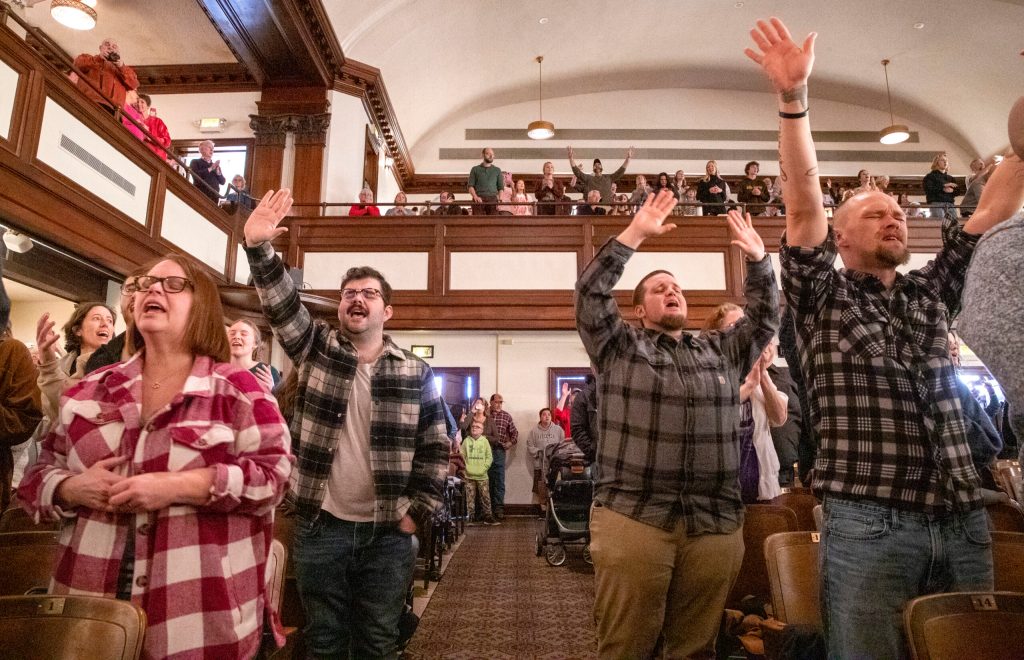
It has been my experience that most Christians want the worship they participate in to be good. But why they think it should be good and what they believe constitutes good worship varies quite a bit.
I’m not sure that I’ve ever had a conversation in which someone has explicitly shared why they think worship should be good. Honestly, maybe that’s a question us pastors should be helping to answer: Why should worship be good? But in conversations surrounding worship, I’ve picked up on a few reasons why people think worship should be good.
Reason 1: People will want to come to our church.
Some people want the worship at their church to be good so that they can attract more people to come to their church. I so appreciate the desire people have to want to invite their neighbors to church to connect with their Creator, don’t get me wrong. But there’s a fundamental issue that underlies this reason. This shouldn’t be the primary reason we want worship to be good because it makes worship about what our church can gain. It makes worship about helping your church grow. But worship isn’t about you or your church; it’s about God. If we think worship should be good because it will bring people into the walls of the church, we use worship as a means to an end, not as the end it was intended for.
Reason 2: Good worship makes me feel the way I want to feel.
I hear some people talk about their worship service at church and say, “I just leave feeling inspired,” or “It helps get me through the week.” Again, don’t get me wrong; there’s nothing wrong with the feelings worship cultivates within us. Communing with God and fellow believers should be sustaining for our faith journey. But if this is the primary reason we want our worship to be good then, again, this makes worship about ourselves and what we can gain. It’s yet another means to an end: good worship is the means to make us feel good.
Reason 3: If our worship is good enough, God will give us what we ask for.
I have come across some people who believe—consciously or subconsciously—that their worship can motivate God to answer our prayers quicker or more favorably. After all, they reason, if our worship pleases God, He will give us what we want. You may already have filled in the blank: this is (again) making worship about us and turning worship from an end into a means to get us what we want.
But let’s dive in a bit further on this reasoning. There are two fundamental problems with this idea. First, it moves Christianity to the cusp of paganism. “Paganism?!” you may say. “We’re worshipping Jesus! How is that like paganism?!” I’m glad you asked.
Paganism says that if you do the right things, in the right way, at the right time, with the right people, etc. then a deity will accept your worship and give you what you ask for. Think about the stereotypical concept of a rain dance: if you follow the right ritual, the deity will give you rain. In other words, if the humans do things the right way, they can force the hand of the divine.
This isn’t a Christian belief. The God who can cause a worldwide flood and yet calm a storm with a spoken word cannot be controlled by humans. His hands can never be forced. (Hence the scandal of the cross: though His hands couldn’t be forced, He allowed them to be nailed.) There is nothing that we can do in worship that would be “good” enough to force or persuade God to give us what we want.
Which brings up the second problem with this reasoning. Some people may think, “Of course I don’t think I can force God’s hand. But if I make Him happy enough, then maybe He’ll want to give me what I want.”
We think of God like a substitute teacher I had in high school: if you buttered her up enough, she’d let you do whatever you wanted. But is that the way God is? Giving to those He’s happy with and withholding from those He’s not? Doesn’t the Bible say that “while we were God’s enemies,” He died for us so that we could be reconciled to Him (Romans 5:10)? That doesn’t sound to me like someone who gives to whom they are happy with and withholds from whom they aren’t.
Our worship doesn’t force or persuade God to do anything. Rather, it’s a response to what God has already done and has promised to do.
Reason 4: God expects our worship to be good.
In some worship services and traditions, there’s a (typically) unspoken reason for why our worship should be good: God expects it.
The more I think about this reasoning though and the people I’ve heard that hold to this reasoning, the more I realize that they don’t just think that God expects our worship to be good. They think that God expects our worship to be perfect.
This understanding of why worship should be good may not be so much a misunderstanding of what worship is, but rather, who God is.
God isn’t a baseball scout who expects us to pitch our best stuff on the mound every time He’s in the stands. He’s not an employer filling out a performance review, wondering if we should get a raise or be fired. He’s not a food critic inspecting every micron of a meal looking for something that can prompt a scathing review. He’s a Father.
Sometimes I like to think about our worship like a toddler’s drawing. Have you seen a toddler hand their parent a drawing? They do so not because they want a treat or to stay up past their bedtime (and it would be weird for their parent to respond to the drawing with: “This is great, why don’t we extend your bedtime by 10 minutes?”). They do so because they love their parent and want to show them that love.
Now imagine with me the parent’s response to the toddler’s drawing. Chances are, it doesn’t look good. It could look like a dog or the sky or a self-portrait or a combination of all three. Mostly, it looks like a feeble attempt at abstract art. But what is the parent’s response? “Well son, you know that I majored in impressionist art in college and that your mother took first place in the county-wide art show with her painting. I expected something better than this.” I certainly hope not!
The parent doesn’t expect the drawing to be perfect. The parent knows that the child sat silently at the kitchen table, eyebrows furrowed, as they meticulously chose whether they should pick up the blue or green crayon, desperately trying to keep their little hand still enough to draw a straight line. The parent doesn’t expect a blue ribbon-winning masterpiece. They simply delight in their child’s attempt at something good.
It’s this fourth reason that troubles me the most; not necessarily because it’s the “worst” reason, per se, but because I’ve seen just how damaging that reasoning is to worship leaders, planners, and pastors alike.
If we worship planners believe that God expects our worship to be flawless (for whatever reason we believe Him to expect that… and I think the reasons are ample), or if we hold our pastors and worship leaders to that expectation, then we risk stepping onto a treadmill of perfectionism in worship as we run harder and harder after something that will never be attained: perfect worship.
But is that what we’re called to—worship that is “perfect”? Or are we called to plan and lead worship that is “good”? And what’s the difference?
Perfection is about being flawless. Goodness is about being excellent.
Let me explain.
Several months ago, someone asked me what makes worship “good.” In the spur of the moment, I responded something like, “It’s doing the best you can with what you’ve got. It’s about excellence, not perfection.”
This is the simplest version of the paradigm I’ve used to evaluate worship over the past few years: Excellence over perfection. Excellence doesn’t care about if everything is perfect. It doesn’t judge based on some idealistic fantasy. It wants you to give the best of what you have and not worry about the outcome.
Too often, I think worship planners get caught up in trying to make everything so perfect that we end up planning worship that isn’t “good.”
Good worship looks like bringing the fullness of yourself and not worrying about giving what you don’t have. It’s about blessing that which you’re able to give, not condemning that which you aren’t able to give. If your worship leaders are constantly thinking about what they’re doing “wrong,” then it’s not good worship.
Good worship invites others into worship. If the music is well-rehearsed and the preacher preaches a fiery sermon but it doesn’t lead others into worship of their Creator, then the worship wasn’t good.
Good worship cares about the worshippers, whether those on the platform or those in the congregation. If the worship you are planning burns your leaders out or doesn’t meet the congregation where it’s at spiritually, then it’s not good worship.
By this point, you may have scrolled back up to the top of this blog post thinking, “This was supposed to be about the Asbury Revival/Outpouring, right? Why the tangent on good worship?”
Because the worship at the Outpouring was some of the best worship I’ve ever participated in and yet it was far from “perfect.”
The Outpouring began with a regularly scheduled worship service at Asbury University. Multiple people at the original Chapel service said that it wasn’t an amazing sermon or concert-level music. And yet, it went on for two weeks.
Even in those two weeks, the technical aspects of worship were quite flawed. When unplanned worship goes on nearly non-stop for two weeks, there isn’t time to be consumed with perfectionism. There were times when the instruments didn’t sound particularly “good.” Guitars were out of tune, drums were off-beat, singers weren’t warmed up.
What if God doesn’t choose to pour out or withhold His Spirit based on whether or not our worship is perfect?
Asbury University had opportunities to make worship more “perfect,” and chose not to.
People from around the world were flying into Wilmore (actually, they were flying into Lexington and driving into Wilmore… Wilmore isn’t big enough to have a middle school, much less an airport). Some of these people were famous Christian worship leaders. Out of (what I believe was) the goodness of their heart and a desire to relieve student musicians from the physical and emotional exhaustion of leading worship 24/7, these professional worship leaders offered to help lead worship.
I love what the University’s leadership responded with: “Thank you so much for the offer. But we’ve got this.” Not out of pride or stubbornness or protection. But out of a desire for this movement of God to be led by the Gen Z students with whom it began.
They knew that these artists with hits on the radio would sound “better.” But does that make it “better” worship? Or did God simply want the best that the students would offer? Not out of an expectation, but simply because, when we love someone, we want to give them the best we have.
Maybe that’s what good worship is: giving the God we love the best we can offer. Some days, when we’re feeling rested and energized and like everything is going right, that may look like perfect pitch and right rhythm and all that jazz. Some days, when it takes all we have to get out of bed and into a worship service, it may look like just showing up and letting God’s grace sustain us.
Maybe we’re more like that child artist than we like to think. God is constantly being serenaded with angels in the highest realms and yet he delights in yours and my worship, flawed as it is. God doesn’t care as much about the quality of our worship as He does the heart behind it.
Somehow, we have to find a way to pursue the holy desire to participate in good worship without falling into the perfectionistic trap that binds church leaders and worshippers alike.
By the grace of God, the worship during the Asbury Outpouring found that balance.
May a revival of how we approach worship spread to those under steepled roofs and in darkened auditoriums every Sunday, so that we may know our Father’s delight in our “good”—but certainly not “perfect”—worship.
There’s more to be said about “good” worship. Maybe that’ll be another blog post some day. But it suffices to ask the questions: What does “good” worship look like in your worshipping context? Are you too busy pursuing some ideal of “perfect” worship, when what God really calls you to is a loving heart in “good” worship?
Afterword/Disclaimer:
This is probably a good time in my life to give a bit of a lengthy disclaimer. The views I express in my blog are simply my views. They do not express the views of my church, denomination, or any other organization to which I am in relationship with. That being said, every person and organization I am in relationship with has influenced my own thoughts, just as I influence the people and organizations I am in relationship with. I never seek to harm the people and organizations I love with my words, both written and spoken. If anything, I seek to help others grow through my words.
Secondly, my views will (hopefully) change over time. Changing views is a sign of growth and learning. Therefore, some of what I write may be something I will later disagree with. That’s okay with me. After all, as I mentioned in one of my very first posts, one of the primary purposes of me writing this blog is to “scrape the fungus off my thoughts.”
Thanks for being here as I do so and for extending grace to me when my thoughts aren’t fully in line with God’s best for our lives!
Did you like this read? I’d love for you to sign up to get my blog posts via email every time I post a new blog!


 Hunter Bethea
Leave a comment