This past June, my wife and I moved from Wilmore, Kentucky, where we lived the last six years, down to Wetumpka, Alabama. We had moved before; in fact, in my six years in Wilmore, I had four different residences. But each of those moves were less than 2 miles away. Plus, over the four years of our marriage, we had acquired a few more things.
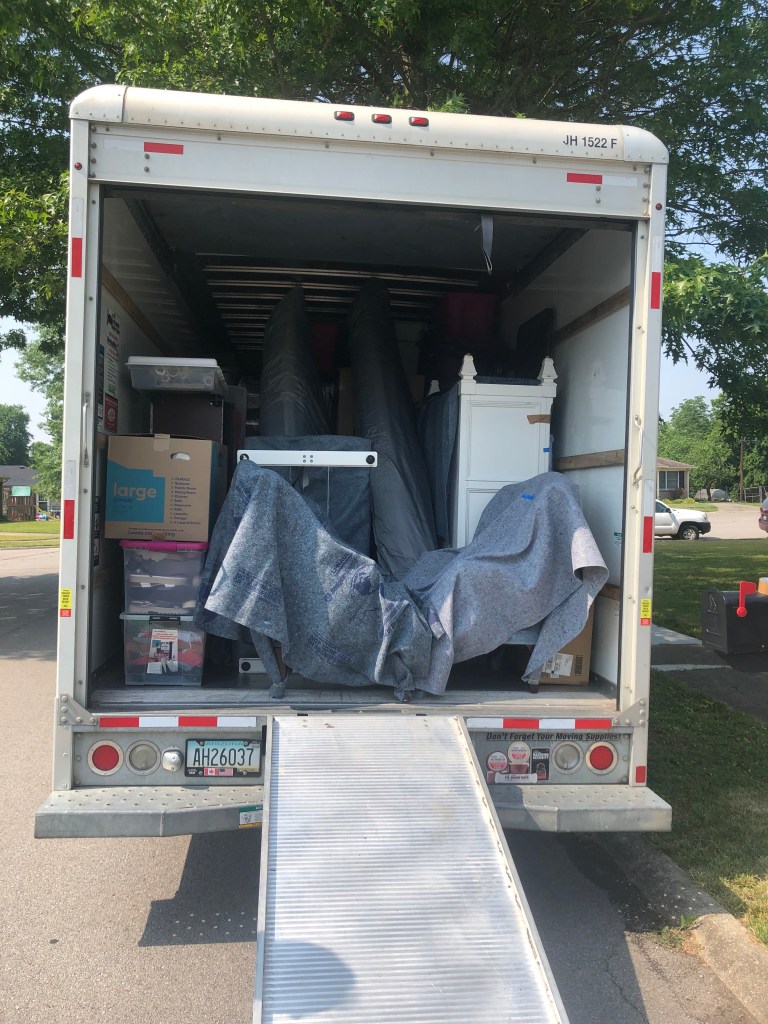
With the promise of pizza, several friends and a couple strangers showed up to help us move. (In full disclosure, all of them would have shown up even if pizza wasn’t involved because we’ve got amazing friends.) As with most moves, you quickly learn who on the team is the muscles, who on the team is the Tetris Master, and who on the team ensures everyone is hydrated.

The Tetris Master was identified very quickly. One of our friends hopped on the back of the U-Haul truck and began pointing and directing the Muscles.
“This goes there,” he’d say. “Then that will fit perfectly underneath,” he’d say before we picked up the first item. He was right; every piece he said would fit perfectly did.
Everything was going wonderfully. It didn’t last long, though. An hour or two into packing the truck, tragedy struck. He had to take an important phone call, leaving our crew Tetris Master-less.
The Hydration Coordinator jumped in: “Everybody, there’s waters in the fridge! Why don’t you take a break and drink some water?” After a few minutes, the important phone call was still going and we were trying to make it to northern Alabama by nightfall.
So, sheepishly (okay, fine. I’m being a bit melodramatic… I don’t do things sheepishly), I said: “I’ll try. I can figure out where things go.”
And it worked. Not well, but it worked. After lots of trial and error, we were making progress. Slowly… but progress nonetheless.
But then, I got stumped. A gaping hole in the middle of the truck emerged. “That box will fit,” I said. Except that it didn’t.
“Oh, how about the nightstand?” Still didn’t fit. “The chair?” Nope.
I stood there, staring at the hole. I could swear it was taunting me.
And then I remembered what every leadership class I took in seminary taught me: Don’t tell people what to do. Tell them what you want done.
I called one of the Muscles onto the truck. “I’m looking for something to fit into that hole,” I said.
Without hesitation, he said: “Oh! I know what will fit!” He jumped off the truck and moments later, reemerged with a perfectly-sized box.
It slid in the hole like a hand in a glove.
What I realized was this: I had been so focused on telling the other Muscles how I wanted the hole filled instead of simply telling them that I wanted the hole filled. I knew the truck; I knew what I wanted the end goal to be. They knew every item waiting to be loaded. It only made sense for me to tell them what I wanted done and let them decide how to accomplish it.
In leadership classes in seminary, we talked often about the Solo Heroic Leader: the man or woman who tries to be the hero of every leadership situation. When I phrase it that way, it’s easy to see why this model of leadership is an issue. Nobody should always be the hero.
Often, though, it’s not because the Solo Heroic Leader (I’ll call them the SHL for the rest of the article) wants to be the hero. I’ve seen leaders who think they’re being humble, who don’t want to burden others with the responsibility of leadership. “This seems like a lot to put on a volunteer’s plate,” they’ll convince themselves. “I’ll just do it.” Or, “They have so much on their plate already. I can handle it.”
Sometimes, leaders become SHLs because they have too narrow of a view of the “right” way to do things. Our customers are used to things this way, so I’m going to make the decision and tell others how it will be done, they’ll subconsciously think. My boss will kill me if it’s not done her way, they’ll worry. It’s easier if I just do this.
I’ve seen a lot of SHLs in my life. Unfortunately, I think that the majority of pastors I’ve known have been plagued by this condition. I could write books about each danger to being a SHL, but I’ll just mention some of them: burnout; not honoring others’ gifts; stifling creativity; limits of the leader’s time and energy; not giving others leadership opportunities; killing an organization when you leave.
Simply put: Solo Heroic Leadership is one of the most prevalent and least helpful ways to lead.
In one textbook, I was introduced to another name for Solo Heroic Leadership: The Genius with a Thousand Helpers. I like this name because I think it highlights the way that that SHLs view those around them: not as teammates, colleagues, peers, creative thinkers, equals, or partners. “Helpers.”
The Genius with a Thousand Helpers points and says to others “Do this.” Good (non-Solo Heroic) leaders turn to those around them and say: “Here’s where we’re going. How should we get there?”
Often this is called “casting vision.” I just call it good leadership. And for a few minutes on the back of a U-Haul, I wasn’t practicing good leadership.
A mentor of mine encouraged me to “Bring people into the anguish of a decision.” (It was either “anguish,” or “agony,” I can’t remember.)
It was a helpful bit of advice. I tend to feel pressure from others (including myself) to be a Solo Heroic Leader. I want to have all the answers, be decisive, and (most importantly) be right. But I can’t have all the answers; I can’t always be decisive; I’m not always right. In fact, all of those are quite rare for me.
What my mentor is encouraging me to do is just be honest with those around me. “Here’s the predicament. I don’t know the answers. But I’d love your help in making a decision.” At the end of the day, as a leader, I’m still responsible for the decision. After all, it’s my stuff on the U-Haul. But we’ve made the decision together. Not only does this often lead to a better decision, but it produces buy-in from the whole team.
I would know. My mentor brought me into the anguish/agony of a recent decision he was making. There was no good answer, so he brought the decision to me and some others. He told us what hole needed to be filled and we talked about what boxes might best fit. In the end, a decision was made. It wasn’t a perfect fit (like I said, there was no good answer), but because we all got to throw around ideas and talk about different options, I’m now bought into the decision that was made.
I began the day we were moving to Alabama by saying: “Just make it through today.” I never expected that I’d learn a lesson I’d carry with me these last nine months. But every time I’m stuck and realize that I don’t know what I’m doing, I think back to the U-Haul, look at the people around me and say:
“Here’s where we’re going. What can we do to get there?”


 Hunter Bethea
Leave a comment