On a seemingly random Wednesday in February or March every year, you’re liable to run into someone with a big black smudge on their forehead or hand. That’s embarrassing, you might think. Someone should tell them. Someone other than me.
Depending on whether you are a churchgoer and what type of church you attend, it might eventually dawn on you when you see the second, third, or fourth person with a smudge on their forehead or hand: Ash Wednesday, the first day of a season of the church calendar known as Lent.
What is Lent?
Ash Wednesday is the first day of the season of Lent, a 40-day season (not including Sundays) leading up to Easter. So the “seemingly random” Wednesday can actually be calculated by taking Easter Sunday (which seems even more random: “celebrated on the Sunday following the first full moon after the vernal equinox,” as decided at the Council of Nicaea in AD 325) and counting 40 non-Sunday days ahead. (Or you can just Google “Ash Wednesday [Year]” for a much easier calculation.)
The English word Lent comes from Old English lencten (related to the Germanic word for ‘lengthening,’ i.e., the lengthening of days in spring).
Historically (and still in many church traditions today, especially in non-Western countries), Lent was a season in which new converts to Christianity were prepared for their baptism. It was also a time when those who had committed sins so serious that they felt they needed to leave the church were reconciled with the community and welcomed back into the community, reminding the church that sin separates us from God but that God Himself welcomes us back into His family through the blood of Jesus.
Historically many Christians fasted, often taking only one main meal a day and avoiding meat; some still observe similar practices today. Sundays, though, were a day of feasting where they would eat their usual meals.
Today, Lent continues to be a season of fasting, prayer, self-denial, self-reflection, and repentance as we follow our Lord and Savior to the cross.
Why not Sundays?
So why do we say that Lent is “the forty days leading up to Easter, not including Sundays” rather than just “the forty-six days leading up to Easter”? That’s because Sundays aren’t a part of Lent!
Even though it is good and right for us to practice repentance, fasting, and self-denial as Christians, we also need to remember that Christ has died, but Christ has also risen and Christ will come again! Each Sunday in Lent is a “mini-Easter” where we celebrate the resurrection of Jesus.
For many who fast or abstain from Sunday during Lent, they break that fast/abstention on Sundays as a reminder that—even amidst journeying with Jesus to the cross—it is good for us to stop and remember that we follow a risen Christ.
When did the Church start celebrating Lent?
The practice of Lent developed over the period of a few centuries in the church. As mentioned earlier, the date for Easter was standardized by the Council of Nicaea in AD 325 (though some Eastern churches have a different Easter Sunday because of the differences in the Gregorian and Julian calendars). Also at the Council, it was decided that there should be a 40-day fast called Lent.
The significance of 40 days for a fast comes from Scripture. In Exodus 34, when Moses was receiving the covenant from God as established in the Ten Commandments, he fasted on Mount Sinai for 40 days. After his great showdown with the prophets of Baal on Mount Carmel, Elijah fasted on his 40 day journey of preparation for his meeting with God on Mount Horeb (1 Kings 19). Most famously, after His baptism, Jesus fasted in the wilderness for 40 days in preparation for His public ministry (Matthew 4, Luke 4).
Despite establishing a 40-day fast for Lent, it wasn’t standardized for this fast to be connected to Easter. In AD 601, though, Pope Gregory established the start of Lent (and therefore, established Ash Wednesday) as 40 days before the start of Easter, not including Sundays.
Why do we celebrate Lent?
The church calendar (pictured below) is formational in nature, designed to connect us to the story of Jesus and the story of the people of God (the Church). It gives us various seasons to focus more intentionally on parts of our Christian lives. For example, the season of Advent helps us grow in the waiting that we as Christians do. The season of Christmas helps us grow in being incarnational: being God’s ambassadors to all the earth. The season of Epiphany helps us grow in recognizing God in all parts of our lives. The season of Easter helps us live with hope that all things will be “made new” because of the resurrection. Pentecost helps us live in the power and boldness of the Holy Spirit. As you can see, all of these were perfectly embodied in Jesus. The church calendar is formational, a tool God uses to shape us to become more like Jesus.
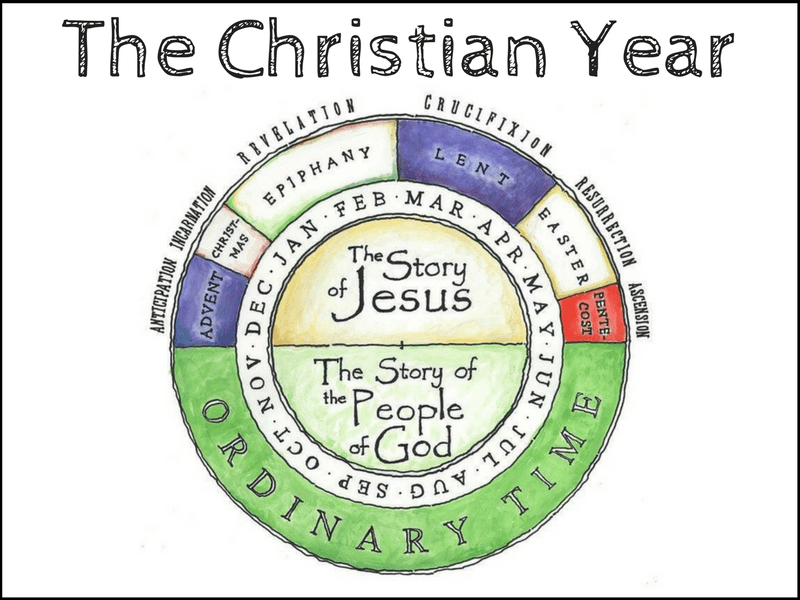
Lent helps us grow into the likeness of our Suffering Servant-King, Jesus. By following Jesus in Scripture as He journeys towards the cross, we are reminded that the Christian life isn’t a life of avoiding pain, discomfort, or persecution. Rather, it’s a life of following our Lord into the pain, discomfort, and persecution knowing that, in following Jesus through those, we also get to follow Him in His resurrection (Romans 6:3-7).
Therefore, Lent is a season of preparation. Just as the early Christian converts would prepare for their baptism by putting off things (food, sins, other loyalties other than to Christ) so that they could take on Christ, we are invited to put off things that keep us from following Christ in His fullness.
Some think of Lent as solely “depressing” or sorrowful. I understand that reaction, but I’d suggest another angle. It’s a season of facing the reality of what it means to be a Christian. A season when we prepare ourselves for whatever we follow Christ into—up to and even including death—so that when we face those times in life, we feel prepared to make the choice to continue to follow Christ.
Lent is a reality-check: are you really ready to follow Christ wherever He goes, knowing that this Jesus went to a cross to die? Can you, like Thomas, say, “Let us also go [with Jesus], that we may die with him” (John 11:16)?
How do we celebrate Lent?
In the Methodist world from which I speak, there’s no “prescribed” way to celebrate Lent. At Ash Wednesday services, we place ashes on foreheads and hands in the shape of the cross, reminding ourselves what we’re heading towards. Many people fast or abstain from something during the non-Sunday days of Lent. I’d invite you to ask the Holy Spirit how He might be challenging you to deepen your loyalty to God this season.
Below are a few ideas for how you can celebrate Lent:
Go to an Ash Wednesday Service
When we put ashes on the foreheads and hands of those in attendance of our Ash Wednesday service, we say, “From dust you have come, to dust you shall return. Repent and believe the gospel.”
That may sound depressing, but I’d like to counter that by saying that it’s actually a hopeful statement. It is true that you have come from dust (Genesis 2:7) and that you shall return to dust when you die. Without the gospel (literally the “good news”), that would be true. But the gospel reminds us of this: returning to dust is not the end of the story. For those who follow Jesus all the way to death, they will also follow Jesus in His resurrection. We will live with God and be the people God has created us to be forever!
Ash Wednesday and Lent are really good times to talk about death, that ever-avoided subject for so many people. It’s an opportunity to talk about Jesus’s death and remind ourselves and our families that death is not to be feared because, for those who profess their faith and live out their loyalty to Christ, “death is just a doorway into resurrection life” (“Christ by Magnified,” Cody Carnes).
Fast (or Abstain)
Another way to celebrate the season of Lent is to do what Christians have done for centuries during Lent: fast. Fasting is—quite simply—going without food for a set period of time. It’s a way to deepen our dependence on God, a great way to remind us that our top loyalty should be Christ and Christ alone. Many also choose to abstain from something during Lent—sweets, sodas, TV, social media, cursing—anything that prevents us from growing closer to God.
(If you’d like to learn more about fasting, I’ve written a blog post about fasting and dependence.)
Go Deeper in Prayer
I have found that Lent is a great time to slow down and go deep in prayer. Maybe God is inviting you to a daily habit of prayer. Maybe He’s inviting you to a different kind of prayer. Maybe He’s inviting you to pray for someone or something that you haven’t prayed for before.
Prayer can be one of those ways that we remember some of the focuses of the season, particularly self-denial, self-reflection, and repentance. Invite God to form you through prayer over the season, not necessarily all at once. Maybe you realize that you’re plagued with pride or lust or despair. What would it look like to invite God into the transforming work of uprooting those sins out of your life?
(If you’d like to read five tools I’ve found helpful for prayer, you can check out this blog post.)
Invite Someone to Church
As I reflect on the fact that Lent has historically been a season when people come back to church, I wonder if Lent might be a season you invite someone to come to church with you. Maybe it’s a neighbor. Maybe it’s a family member. Maybe it’s a coworker or someone who used to be a regular at your church. Heck, maybe it’s all of the above (after all, there are 6 Sundays in Lent!).
A Personal and Pastoral Word about Lent
I hope this blog post gives you more insight into the season of Lent. My hope, though, is not that you’re more informed about Lent solely for information’s sake. Rather, my hope is that this information leads to greater meaning and purpose for your season of Lent.
To be honest with you, Lent can be a hard season. Don’t shy away from its hardness. If you read the stories of Jesus on the way to the cross, those stories are hard. Following Jesus is hard. But my prayer for you is that, in leaning into the hardness of the season, you’ll experience newfound joy in the season to follow, the season of Easter.
To know good, we must know bad. To know joy, we must know pain. Don’t be afraid of the challenges presented in Lent. Lean into them, knowing that the God who carried a cross on His back knows a thing or two about challenges. But He defeated the grave once and for all so that you and I could have life and life to the fullest.
So, welcome to Lent! May it be a season of deep meaning. Of shedding that which detracts us from the road that Jesus is on. Of recognizing that pain and hardship never have the last word. Of knowing the truth that Easter is coming.
Thanks for reading! If you’d like to learn more about another season in the church year, the season of Advent, check out my article on the season of Advent.
If you’re new to my blog, welcome! I’m glad you’re here. I’m Hunter Bethea, a follower of Jesus, husband, father, Global Methodist pastor, and curator of books I don’t have time to read. You’re welcome to learn more about me here.
I primarily write about faith, family, and leadership, all in the Wesleyan language. If you’d like to receive my newest blog posts in your email, sign up below. Also, if you’d like to check out my Facebook page (where I share more than just my blog posts), check it out here!
And finally, here are some of my most recent blog posts if you want to read more!
- Why Do We Celebrate Lent?
- What We Lose When We Forget the Image of God
- Fasting and Abstinence: A Path to Dependence on God (the 19)
- The Five Best Books I Read in 2025
- Why Does Good Theology Matter?
Sources:
“The Biblical Foundations of Lent and Ash Wednesday” by Museum of the Bible
“What is Lent and why does it last forty days?” by Ask the UMC
“What are the origins of Lent?” by Ministry Matters
“A Service of Worship for Ash Wednesday from the UMC Book of Worship


 Hunter Bethea
Leave a comment